
SafeAllergy - Allergen Scanner

Installs
MedCoderX
Developer
-
Food & Drink
Category
-
Everyone
Content Rating
-
https://www.safeallergy.app/privacy-policy
Privacy Policy
Screenshots
editor reviews
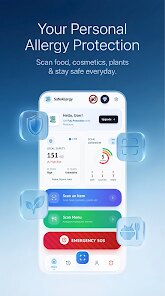
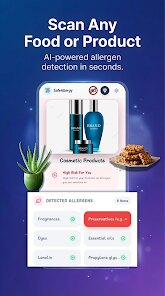
Living with food allergies isn't just about reading ingredient lists anymore. It's a constant balancing act of trusting food manufacturers and hoping their packaging is accurate. I've been using the SafeAllergy - Allergen Scanner developed by MedCoderX, and honestly, it's changed how I approach grocery shopping and eating out. At its core, this application uses your phone's camera to scan product barcodes and cross-reference them against a massive database of allergens, offering near-instant feedback on whether something is safe for your specific dietary restrictions. The main user base is clearly anyone managing food allergies, sensitivities, or autoimmune conditions like celiac disease, but it's equally useful for parents of allergic children or people following elimination diets. I've personally struggled with hidden sources of dairy in processed foods, and this app has caught several items I would have assumed were safe based on casual label reading. It solved the specific problem of ambiguous labeling and "may contain" statements that manufacturers often bury in fine print. The core scanning function works remarkably well in most grocery store lighting conditions, processing barcodes within two to three seconds on average. What surprised me most was the inclusion of restaurant menu scanning—letting me snap a picture of a menu and getting instant allergen flags. I'd recommend this app most strongly to anyone new to managing food allergies who feels overwhelmed by label reading, as well as seasoned allergy warriors who want that extra layer of verification. It's definitely most useful during grocery shopping trips or before visiting a new restaurant, though I use it occasionally to double-check items already in my pantry.
The app's design prioritizes simplicity over flashy graphics, which I appreciate when I'm in a hurry at the store. You set up a profile with your specific allergens, and the scanner only flags those particular items rather than overwhelming you with every possible allergen on earth. This focused approach means faster results and less unnecessary alarm. I found the saved scan history particularly valuable—creating a personal database of safe products I can refer back to without rescanning. The offline mode deserves special mention here, since grocery stores often have spotty reception, and the app stores recently downloaded product data for scanning without an active connection. That said, the initial database sync does require a solid Wi-Fi connection, and the free tier limits you to 30 scans per month before asking for a subscription. For people with multiple allergies or large families, this scanning cap becomes restrictive quickly, making the paid version almost essential for heavy users. The database accuracy feels strong for major brands and chain restaurants, but I've noticed gaps with smaller local producers and seasonal items—a limitation the developers acknowledge in their documentation. These gaps don't undermine the app's core value, but they do remind you that no digital tool can fully replace careful manual label checking.
features
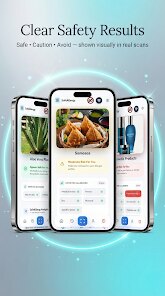
- 📷 Instant Barcode Scanning — Point your camera at any product barcode and the app processes the match against its allergen database in seconds. The recognition engine handles damaged or wrinkled barcodes surprisingly well, though very reflective packaging sometimes requires a couple of tries. What makes this feature stand out is the visual feedback system: a green border means safe, yellow means caution, and red means avoid. This color coding makes quick decisions possible even when you're shopping with kids or in a rush.
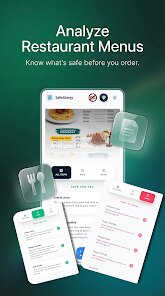
- 🥘 Restaurant Menu Scan — This feature lets you take a photo of any printed menu and identifies potential allergens item by item. The OCR technology works with handwritten specials boards too, though accuracy drops slightly with cursive text. I've tested this at about a dozen restaurants, and it flagged hidden ingredients I would never have considered, like butter in supposedly "vegan" vegetable dishes. Just keep in mind that recipes change frequently, so the app's database lags behind by a few weeks in some cases.
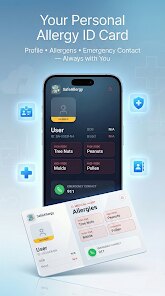
- 📊 Personalized Allergen Profile — You build a detailed profile listing every allergen you need to avoid, including severity levels for cross-contamination sensitivity. The app then customizes all scan results to match your specific needs rather than showing generic allergy warnings. I appreciate the option to add notes for each allergen, like "safe in baked goods but not raw" for certain fruit allergies. This personalization transforms the app from a generic scanner into a truly tailored tool.
- 📱 Offline Database Mode — Before heading to the store, you can download your allergen profiles and recently scanned items for offline use. The app caches the last 200 scanned products automatically, which covers most weekly shopping trips. This feature saved me multiple times at farmers market stands and rural grocery stores with terrible cell service. The trade-off is that offline scans won't catch newly added products or database updates, so occasional online syncs are necessary for complete accuracy.
pros
- ✅ Database breadth — Covers over 800,000 products with 14 major allergen categories, constantly updated through user submissions and manufacturer data feeds. I rarely encounter major brand items that aren't recognized.
- ✅ Speed of scanning — Average scan time under three seconds makes it practical for real-world shopping, not just occasional use. The app doesn't slow down your trip.
- ✅ Cross-contamination notes — Many scans include specific warnings about shared manufacturing facilities or equipment lines, going beyond just ingredient lists. This added detail addresses a major concern for highly sensitive individuals.
- ✅ Clean interface — No cluttered screens or confusing menus. The app puts the scanner front and center with minimal taps required to get results. Even my technophobe parents figured it out in minutes.
cons
- ❌ Scanning limit on free tier — Thirty scans per month doesn't stretch far for anyone with multiple allergies or a family to feed. The subscription isn't expensive, but the limit feels artificially restrictive.
- ❌ Small brand gaps — Local bakeries, farmers market vendors, and regional chains often aren't in the database yet. This creates a false sense of security if you assume all products are covered.
- ❌ Subscription cost — At $5.99 monthly or $39.99 yearly, the price adds up for what is essentially a specialized reference tool. Students and families on tight budgets may find this prohibitive.
- ❌ Menu accuracy lag — Restaurant menus change frequently, and the app's updates take one to three weeks to reflect those changes. This delay makes the restaurant scanner less reliable for trendy spots that rotate menus seasonally.
Recommended Apps
![]()
Astra - Life Advice
Vert Media Partners4.4
![]()
Question.AI - Chatbot&Math AI
D3 DIMENSION TECHNOLOGY PTE.LTD.4.5
![]()
Anima
ChristopherMoore03.2![]()
Suno - AI Music & Songs Maker
Suno, Inc4.8![]()
Name Meaning
Dexati4.1![]()
Reface: Face Swap & AI Videos
NEOCORTEXT, INC.4![]()
Astroscope: Astrology Guide
Astroscope App4.5![]()
Passport Parking
Passport Labs, Inc.2.5![]()
AXS Tickets
AXS, LLC4.2![]()
Call Santa Claus & Prank Call
WELLY GLOBAL PUBLISHING3.5![]()
PawAI: AI Cartoon Pet Filter
Now Tech3.1![]()
Waymo
Waymo LLC4.9![]()
Live football TV
Findy360 Software LLC3.7![]()
Pedometer - Step Counter
Simple Design Ltd.4.8![]()
Face Live Camera: Face Filters
Lyrebird Studio4.1













You May Like
-
![]()
FORCETELLER Astrology & Saju
Team UN7QI34.5 -
![]()
Daily Horoscope & Astrology
TELEMAQUE4.2 -
![]()
Yahoo Sports: Scores & News
Yahoo4.7 -
![]()
Uber Eats: Food Delivery
Uber Technologies, Inc.4.3 -
![]()
How I will die - Predict death
Bimdu3.2 -
![]()
Quiz Reels: Filter Challenge
Now Tech3.9 -
![]()
Broken Screen 4K Funny Pranks
Braly JSC4.1 -
![]()
Prisma3D - Animation, Modeling
Prisma3D2.8 -
![]()
Wonder - LGBTQ+ Dating App
Bumpy Inc.4.3 -
![]()
PicSo – Customize Your AI Girl
Meta Insight3.7 -
![]()
Plant App - Plant Identifier
ScaleUp4.6 -
![]()
Software Update for my phone
Art & Tool Studio4.1 -
![]()
Kling AI: AI Image&Video Maker
Lohas Games Pte. Ltd.4.4 -
![]()
Google Home
Google LLC4.2 -
![]()
Fingerprint Scan Simulator
Dream-Up3.6















Disclaimer
1.Apponbest does not represent any developer, nor is it the developer of any App or game.
2.Apponbest provide custom reviews of Apps written by our own reviewers, and detailed information of these Apps, such as developer contacts, ratings and screenshots.
3. All trademarks, registered trademarks, brand names and company names or logos appearing on the site are the property of their respective owners.
4.Apponbest abides by the federal Digital Millennium Copyright Act (DMCA) by responding to notices of alleged infringement that complies with the DMCA and other applicable laws.
5.If you are the owner or copyright representative and want to delete your information, please contact us [email protected].
6.All the information on this website is strictly observed all the terms and conditions of Google Ads Advertising policies and Google Unwanted Software policy.
7.apponbest.com is an independent, information-only website which is 100% free to all the users.